Fulfillment WMS Warehouse management
One system for every item, from the dock door to the shipping label
Fulfillment WMS runs receipt, picking, packing, labels and returns in one interface, across all your warehouses. You set the rules, and the floor follows them for every order.
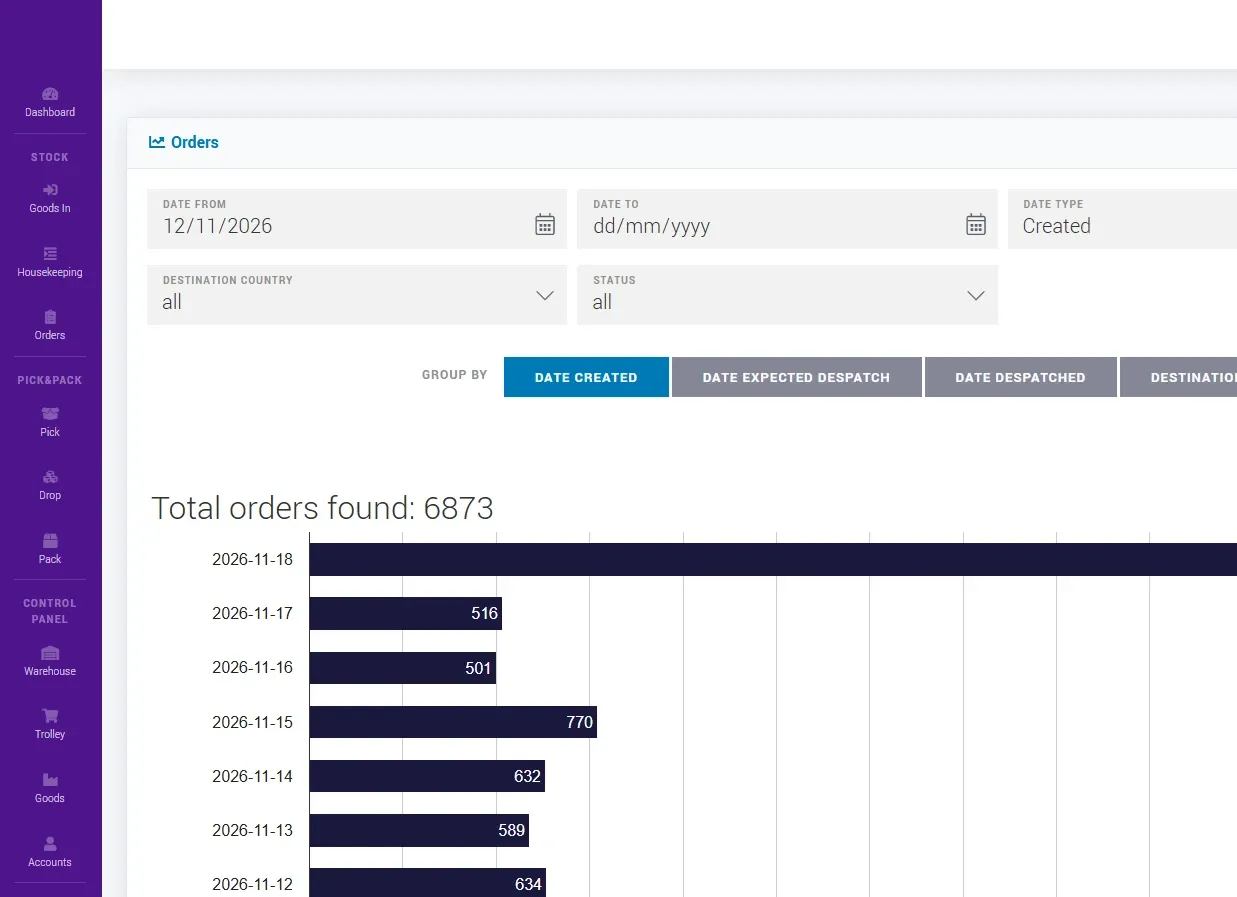
Built for warehouses that have outgrown spreadsheets
High volumes, several sites, and profit that depends on the accuracy of every operation.
3PL and logistics companies
Many clients and several sites, run by one team.
E-commerce warehouses
Volumes that jump in sale seasons and still have to ship on time.
Operators with measuring hardware
Warehouses where scales and dimensioners measure every item.
Configure the rules once. Every order follows them.
Six steps from receipt to shipment. The system plans the work, and people only do it.
Stock arrives and goes to its place
Clients create inbound shipments (ASN) through the API or a file. Stock goes from the ASN straight to its locations. In peak season, it can go to a buffer zone first, and a trust-receipt mode skips unit-by-unit scanning.
Orders come in from every channel
Orders arrive from your stores through the API, SFTP or a CSV file, or you create them in the UI. Backorders wait for out-of-stock items and go to packing when the stock arrives. A substitution replaces a missing item with an equivalent.
One walk picks many orders
The system builds the route and groups items from several orders into one walk. A picker links a trolley or tote to the handheld. Multi-line orders go through Order Bin slots, which pickers fill from one side and packers empty from the other.
Zones, moves and transfers under control
Move stock between zones and check what is in each location. You set up the zones yourself, such as storage, pick and putaway zones, transit totes and packing stations. Transfers move stock between warehouses and keep full traceability.
Weigh, confirm, label
The packing station checks the box weight limit and suggests a split shipment when needed. The shipping label prints as soon as the weight is confirmed. Custom packing slips, inserts and box stickers print from the packer's device.
Every system knows what the warehouse knows
The order status goes back to the store in real time. Every stock change sends the available stock to your stores, your ERP and every connected system.
Five pick modes, one for each kind of order
Single sends one-item orders straight to the packing station. Multi collects multi-line orders in Order Bin slots. Large routes oversized items to their own stations. Bulk prints all labels for identical orders in one action. Wave lets one worker take a whole batch through the full workflow.
- 5 pick modes for different order types
- ~20% faster picking of single-item orders
- 12+ automatic alerts about warehouse events
Everything between the dock door and the label
Turn on what you need. The integrations and hardware support are already built.
Split rules
Split orders by weight, volume or shipment type
REST API and webhooks
Full control of all operations, with event notifications
SFTP exchange
Batch files for high volumes and legacy systems
Store connectors
Shopify, WooCommerce and Magento, plus large marketplaces
Measuring hardware
Weight, size and photos captured in one pass
Visual ID
Product photos on the handheld for items with one barcode
Barcodes and serials
Several barcodes per product and a serial number per unit
Batch tracking
Expiry dates, with alerts for stock that expires soon
Bundles and kits
Virtual sets picked per order, or ready kits shipped as one
Dashboard
Live orders, staff workload, stock and picking speed
Notifications
Alerts for finished receipts, low stock and other events
Billing per client
Your rates for storage, receipt, pick and pack, and returns
Shaped around your warehouse, not the other way round
Your process, not a packaged one
We adapt the platform to how your warehouse works, including custom data, specific integrations and non-standard flows. Dimensioners get their own support, such as photos at a 45° angle and automatic background removal.
Rollout without stopping the floor
Modules go live in phases, so your current warehouse keeps working while the new system starts.
A little more context
ContactsHow does the WMS connect to shipping?
Through V-TER Ship. When the packer confirms a box, V-TER Ship picks the carrier by your rules and prints the label, with the weight and dimensions passed automatically. Last Mile Connect provides the carriers, so the warehouse needs no integration with each carrier.
Can we run more than one warehouse?
Yes. Each site has its own stock and orders, and one interface covers all of them. You can add new warehouses later without changes to the setup.
What does a typical rollout look like?
We connect your order sources, set up the pick rules and the warehouse structure, and start a pilot. You move away from your old system step by step, and you scale when the numbers prove out.
How are returns handled?
As return ASNs. Returned items are received, checked and put back into stock in the same flow as inbound stock. Returns platforms can send them in directly, and Reversecarrier hands over checked items from its hubs the same way.