No revenue leakage
- Every billable parcel event creates its transaction automatically
- Carrier invoices reconciled against the shipments they belong to
- Overlap warnings stop two rate cards claiming one shipment
Shipper billing, carrier rate cards, automated least-cost analysis and margin-based rate card generation in one module, from carrier tariff to client invoice. Every charge traces back to the parcel event and the rate card version that produced it.
One linear workflow: ingest carrier rates, run the analysis, apply margin, approve, deploy. No re-entry and no export-import friction between the stages.
Carrier rate cards extend the standard rate card structure with carrier-level matching criteria: shipping solution, package type, incoterm and IOSS scheme. Overlap warnings flag conflicting criteria without blocking creation.
Select the criteria that apply to your scenario, then the rate cards to compare. A background job identifies the optimal carrier per weight band and destination country while you keep working.
The generated least-cost data shows the best match for every combination in scope, and is downloadable as CSV for finance review, external sign-off or ERP ingestion.
Build a client rate card from the least-cost data: a percentage margin applied uniformly or by condition, surcharges by zone, package type or weight band, and a new rate card version with fully computed final rates.
Each rate card keeps a full version history. Approving a version puts the whole rate card into read-only mode: a hard lock, not a soft flag. Any version can be duplicated as the start of the next one.
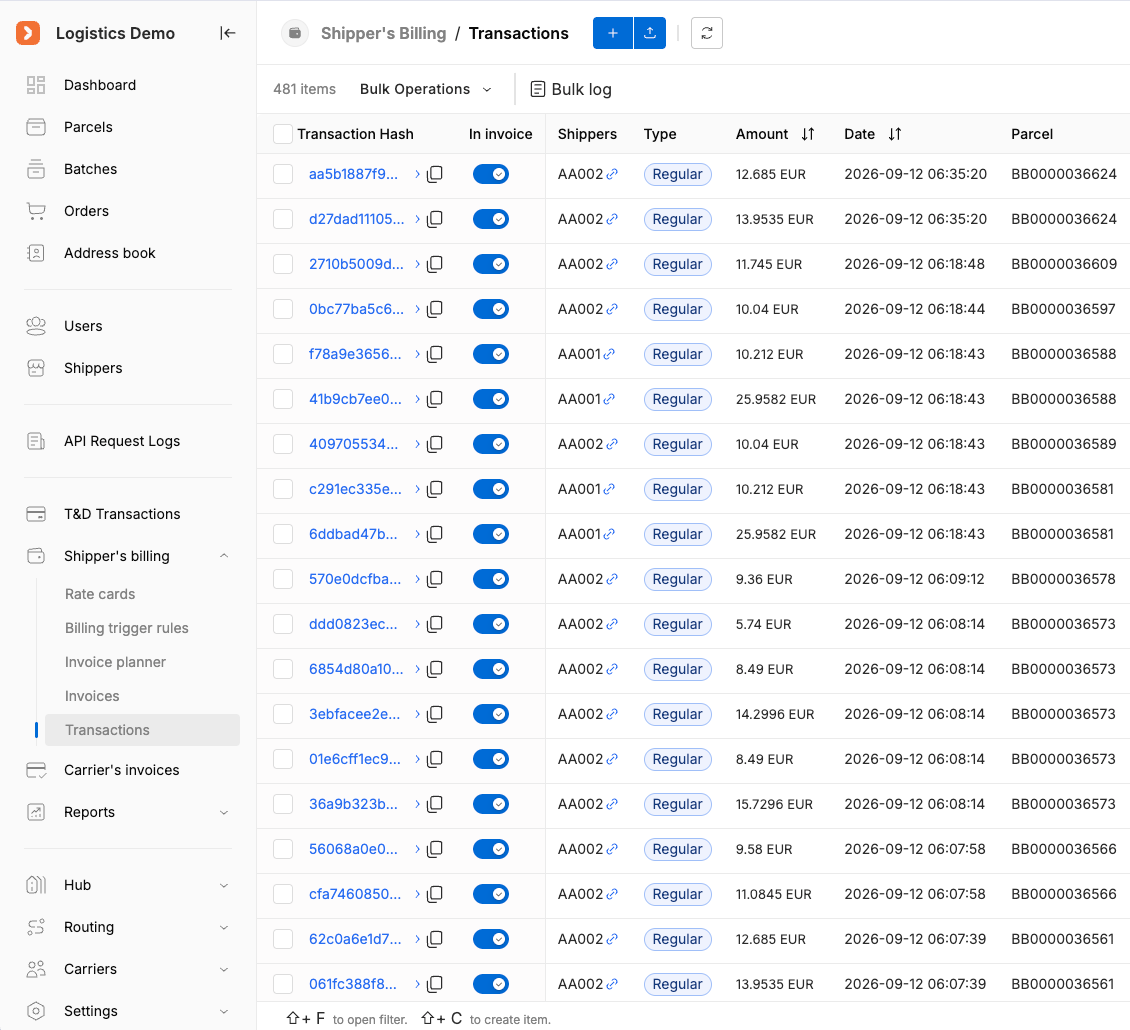
Billing trigger rules define which parcel event applies which rate card. Transactions are created automatically, feed the operational reports, and the Invoice Planner issues invoices on the schedule you set.
Standard shipper billing and a rate intelligence layer in the same system, for operators who need transactional accuracy and carrier rate insight together.
The financial record behind every shipment event.
Multi-dimensional matching criteria so the right rate applies every time, without a lookup.
Created on parcel creation and on billable tracking events; zero manual entry.
Conflicting rate card criteria are flagged before they cause a mis-charge.
Clients, carriers and warehouses billed from one system, each on their own rules.
Carrier cost data turned into client pricing with traceability at every step.
Automated analysis across selected carrier rate cards, per weight and country.
Final client rate cards generated from the analysis, not maintained by hand.
Full history, duplicate-to-edit, and a read-only lock once approved.
Approved rate cards serve as standard shipper billing rates.
Month end without the spreadsheet.
Invoices generated on a configurable schedule per shipper.
What the carrier charged, reconciled against what was billed.
Transaction records feeding directly into operational and financial reports.
Billing errors are expensive twice: once in the leak, once in the dispute. The module removes the causes rather than catching the symptoms.
Every V-TER platform shares one data layer and one API, so connecting two of them is configuration, not an integration project. Here is what each one does for V-TER Ship Billing.
Billing is triggered by V-TER Ship parcel events, so shipping and invoicing close the loop: a label, a hub scan or a delivery event is what creates the charge.
Explore V-TER Ship Carrier connectivity APICarrier rate cards come in through Last Mile Connect, and carrier invoices are uploaded for reconciliation against what was billed to the shipper.
Visit Last Mile Connect (dedicated site) Reverse logisticsThe same rate cards price the return labels V-TER Returns generates, so the forward and reverse legs are billed from one set of rules.
Explore V-TER ReturnsAnyone who buys carrier capacity at one price and sells delivery at another, and needs the difference to be exact.
Incoterm- and IOSS-aware rate cards, with duties and surcharges applied by rule.
Multiple clients in one operation, each with their own rate cards and invoice schedule.
Thousands of parcels a day billed per event, with least-cost routing feeding the price list.
Contracted rates versioned, approved and locked; disputes answered from the transaction record.
It is the billing module of V-TER Ship: transactions are created from V-TER Ship parcel events, which is what makes billing exact. Operators who only need the rate intelligence layer can start there and switch shipper billing on when the parcel flow moves onto the platform.
As carrier rate cards, in the formats carriers publish, linked to a shipping solution and its criteria. Where the carrier is connected through Last Mile Connect, its rate card can be uploaded there and cost calculated per shipment automatically.
Approval. Once a version is approved the whole rate card enters read-only mode; a change means duplicating a version, editing the copy and taking it through approval again, so the history shows exactly what was billed under which version.
Yes. Surcharges are configured by zone, package type, weight band and other conditions, and margin can be uniform or conditional, so one client rate card can carry a fuel surcharge on one lane and a handling fee on another.
Bring one carrier tariff and one client contract. We will show the analysis, the generated rate card and the first invoice in a single session.